Continuous Dust-Free Screening: Why the LOS Series Airflow Sifter is the High-Yield System Solution
Tuesday July-14 2026 15:44:37
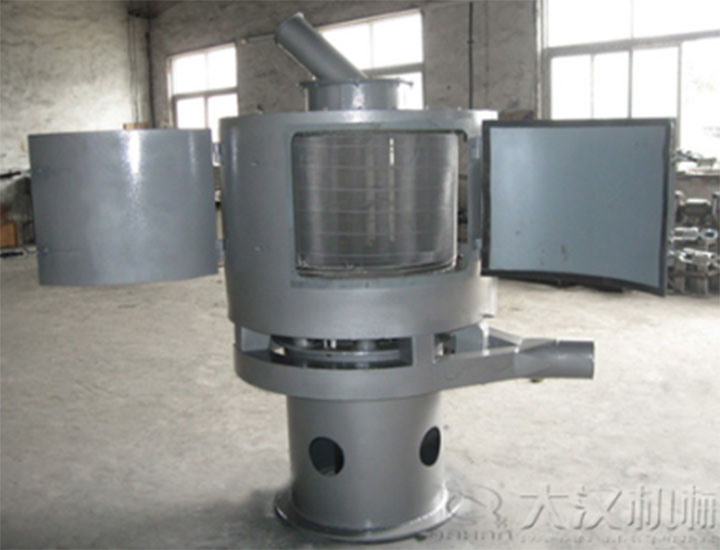
Handling ultra-fine powders above 200 mesh with traditional vibrating screeners often leads to unavoidable mesh binding, material waste, and hazardous workshop dust. Stopping these production losses requires migrating to a dust-free screening machine engineered with a dust-tight enclosed casing. The LOS Series Airflow Sifter achieves this by replacing traditional vibration with air-assisted fluidization. Designed for direct system integration, this high-yield technology maintains continuous, dust-free separation while boosting throughput up to 10 times compared to conventional sifters.
Why Traditional Vibrating Screeners Fail with Powders Above 200 Mesh
Conventional vibrating screeners rely on eccentric weights to shake material through a mesh. While this mechanism works for coarse aggregates, it causes severe operational limits when handling fine powders above 200 mesh. Static electricity and particle moisture quickly cause the mesh to blind, forming a stubborn layer that blocks the screen openings.
This mesh blockage forces frequent production shutdowns for manual cleaning, accelerating mechanical wear and tearing the wire cloth. Beyond cleaning downtime, the violent shaking motion of standard separators degrades equipment gaskets over time. This continuous dynamic stress allows fine particles to escape into the workshop atmosphere, causing measurable material yield loss and failing environmental compliance audits.
The Engineering Principle Behind a High-Efficiency Dust-Free Screening Machine
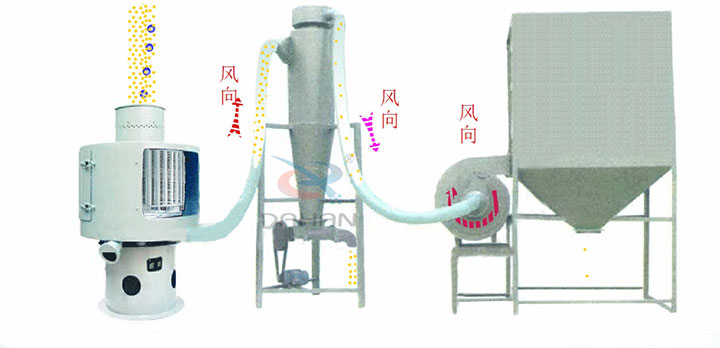
A high-efficiency dust-free screening machine replaces dynamic exterior vibration with a static, enclosed pneumatic separation system. Instead of throwing powder against a horizontal sieve cloth, this configuration utilizes a controlled internal airflow to fluidize the incoming material. A built-in screw conveyor feeds the micro-powder directly into a cylindrical mesh chamber.
Once inside the chamber, high-speed rotating wind blades generate a continuous centrifugal force and fluidizing current. This internal pressure drives compliant fine particles through the static screen cloth to the clean discharge outlet. Concurrently, oversize particles travel horizontally along the cylinder wall to the reject port. Because the airflow loop operates under balanced negative pressure, no internal force pushes fine dust through the casing seals.
Expanded Sifting Capability Across 80 to 530 Mesh Operations
Conventional separation methods fail when grading superfine materials, as particles smaller than 75 microns (200 mesh) quickly blind the screen cloth. The LOS Series Airflow Sifter bypasses this physical threshold by expanding the practical sorting range from 80 mesh down to 530 mesh. By replacing mechanical shaking with pneumatic fluidization, this equipment handles challenging fine powders—including calcium carbonate, epoxy resins, and active pharmaceutical ingredients—without grain agglomeration or oversized particles leaking into the finished product.
5-10x Output Boost with 85-95% Mesh Pass Rate
While gravitational shaking limits standard sifters to low feed volumes, the aerodynamic force within the LOS Series Airflow Sifter actively drives material through the screen. This positive fluidization yields a throughput 5 to 10 times higher than traditional separators occupying the same footprint. Additionally, the rapid mechanical sweep guarantees an 85% to 95% mesh pass rate. This accelerated processing minimizes internal material accumulation and ensures high-accuracy classification, allowing plants to scale production volume without expanding their factory floor footprint.
Production Throughput Comparison (Per Hour)
*Throughput data based on consistent mesh specifications and particle density.
Anti-Clogging Mechanics for Minimal Screen-Residue Production
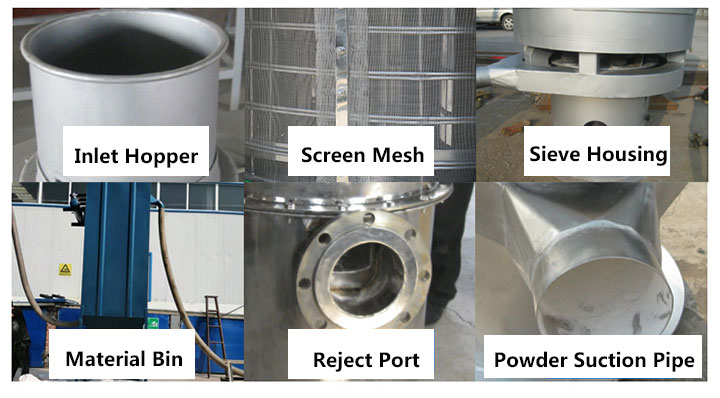
Fine particles typically lodge inside screen apertures due to static adhesion, blinding the mesh within hours. The LOS Series Airflow Sifter resolves this through its continuous air-sweeping action, which aerodynamically cleans the mesh openings during the separation cycle. This constant fluidization prevents particle adhesion and screen blinding, reducing screen-residue volume to negligible levels. By maintaining an unobstructed passage, the system optimizes raw material usage and ensures consistent product quality across long manufacturing runs.
Vertical Screen Configuration for Reduced Mechanical Wear
Traditional flatbed screeners expose horizontal meshes to direct material weight and harsh impact, causing rapid metal fatigue. The LOS Series Airflow Sifter counteracts this by adopting a vertical screen cylinder layout. Because the material is carried by a fluidized current rather than heavy mechanical bouncing, the wire cloth experiences no direct structural loading. This non-contact separation method minimizes localized abrasive wear, extending mesh operational lifespans and reducing the risk of unscheduled maintenance shutdowns caused by sudden screen breakage.
Technical Integration Within Automated Powder Processing Lines
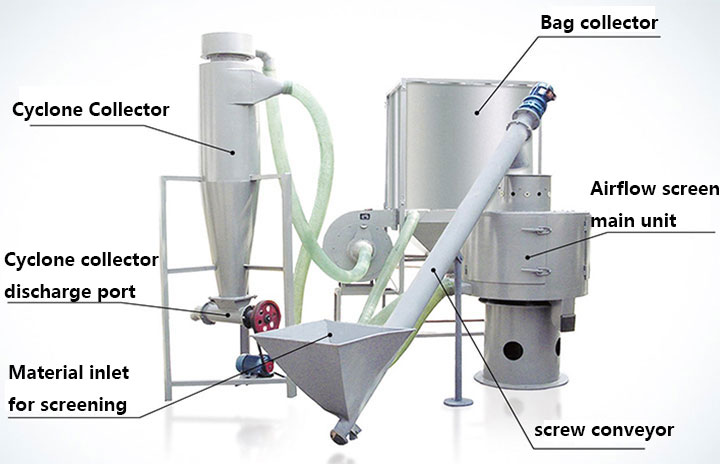
The standalone efficiency of a dust-free screening machine is best realized when embedded directly into a closed-loop production line. The LOS Series Airflow Sifter functions as an inline classification component, allowing direct coupling with positive-pressure dense phase or negative-pressure dilute phase pneumatic conveying systems without introducing air leakage.
1. Pneumatic Feed Inflow (Upstream Coupling)
Micro-powder enters the sealed intake via vacuum piping or a rotary airlock valve, maintaining internal system pressure.
2. Inline Aerodynamic Separation (Processing Core)
The internal balanced loop fluidizes and separates the powder, isolating impurities without interrupting material travel velocity.
3. Closed-Circuit Discharge (Downstream Delivery)
Separated fine particles exit directly into sealed storage silos or packaging hoppers, keeping the environment free of fugitive dust.
Sustainable Efficiency and Process Reliability
Transitioning from mechanical shaking to aerodynamic fluidization redefines bulk solids handling for ultra-fine materials. The LOS Series Airflow Sifter mitigates the frequent occurrences of screen clogging, operational equipment wear, and atmospheric dust emissions. By maintaining stable processing conditions and reliable classification accuracy under challenging mesh parameters, this technology provides plants with a practical pathway toward lower operating costs and consistent manufacturing yields.
Optimizing your powder classification workflow requires precise equipment configuration matching your specific material properties. Contact our application engineering team today for a technical consultation, material testing data, or a custom system layout designed for your facility.