How to Select an Anti-Clogging Sifter for Silicon Powder
Wednesday October-21 2026 17:14:37
Silicon powder is not an ordinary powder. Its hardness, particle size distribution, electrostatic tendency, and bulk density mean that equipment with identical nominal parameters may perform very differently in actual production lines.
Before selecting a model, you should first clarify the material category and characteristics, then confirm the equipment's design details item by item, thereby eliminating most unsuitable models.
Material Category Determines the Starting Point for Selection
Silicon powders of different purities and uses have significantly different requirements for equipment. The first step in selection is not comparing machines, but clarifying material properties.
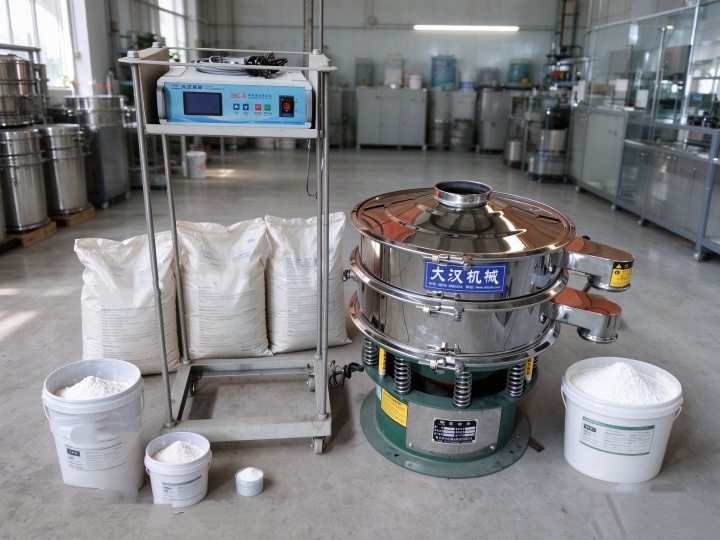
Photovoltaic and semiconductor-grade silicon powder. Extremely sensitive to metal contamination, the content of impurities such as iron and copper must be controlled at the ppm level. Parts of the equipment in contact with the material should preferentially use 316L non-magnetic material or polymer linings, and welded areas need to be polished to avoid material residue and cross-contamination.
Metallurgical-grade and ordinary filler-grade silicon powder. Large output and cost-sensitive, but silicon powder has a Mohs hardness of about 7.0 and is highly abrasive, so wear on the screen mesh and screen body is the main contradiction. In such scenarios, the focus of selection lies in wear-resistant design. The priority of screen mesh material and protective structures at easily worn parts is higher than that of the mesh-cleaning method.
Nano and ultrafine silicon powder. Small particle size, large specific surface area, easy to agglomerate, and there is a dust explosion risk. The equipment must support inert gas protection or wet screening, and sealing level and anti-static measures are mandatory indicators.
How to Solve Electrostatic Adsorption
Silicon powder in dry environments easily generates static electricity, and micron-sized particles will firmly adhere to the screen surface. At this time, increasing mechanical vibration will instead compact the particles and aggravate hole blockage. This is the core reason why blinding in silicon powder differs from blinding in other powders.
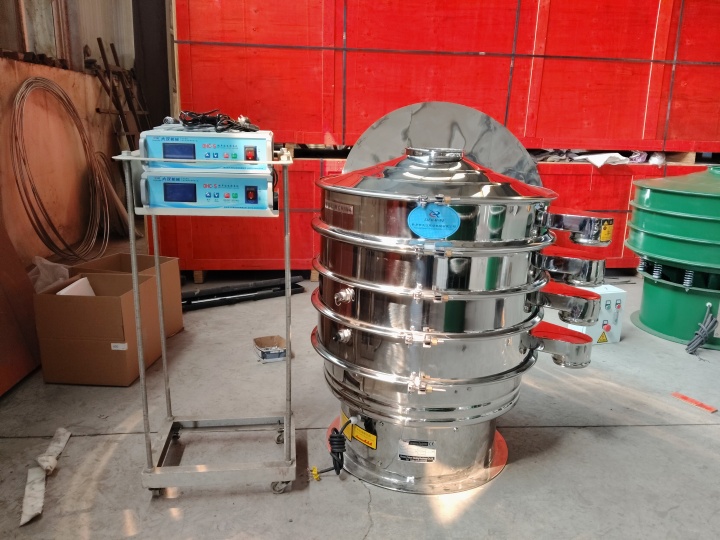
For electrostatic adsorption, the equipment-side solution is an ultrasonic mesh-cleaning system. The amplitude is small and does not affect the normal conveyance of material on the screen surface, but it is sufficient to make micron-sized particles detach from the screen surface and remain suspended and dispersed, thereby suppressing blinding caused by electrostatic adsorption from the source.
How to Select Screen Mesh Material and Screen Body Structure
The abrasiveness of silicon powder is much higher than that of ordinary powders. Ordinary stainless steel woven mesh has a short service life under continuous operation, and frequent mesh replacement means frequent downtime, so the overall cost is actually higher.Two designs need to be evaluated on the equipment side. For the screen mesh itself, for silicon powder working conditions, common choices are 316L woven mesh with thickened wire diameter or polyurethane screen mesh.
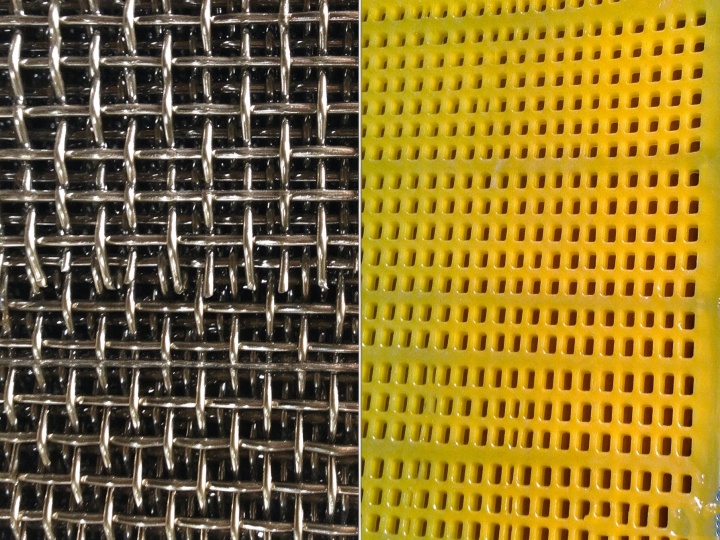
The former is wear-resistant and corrosion-resistant; the latter has good elasticity and resistance to blinding, but the achievable mesh count is lower, making it suitable for coarse screening stages. For easily worn parts of the screen body, such as the feed inlet drop point and the inner wall of the screen frame, which directly bear the impact and friction of silicon powder, whether wear-resistant coatings or replaceable liners are provided determines the maintenance cycle of the entire machine.
Sealing and Environmental Protection
The leakage of ultrafine silicon powder dust is not only an environmental issue but also a safety issue. Excessive dust concentration poses an explosion risk.
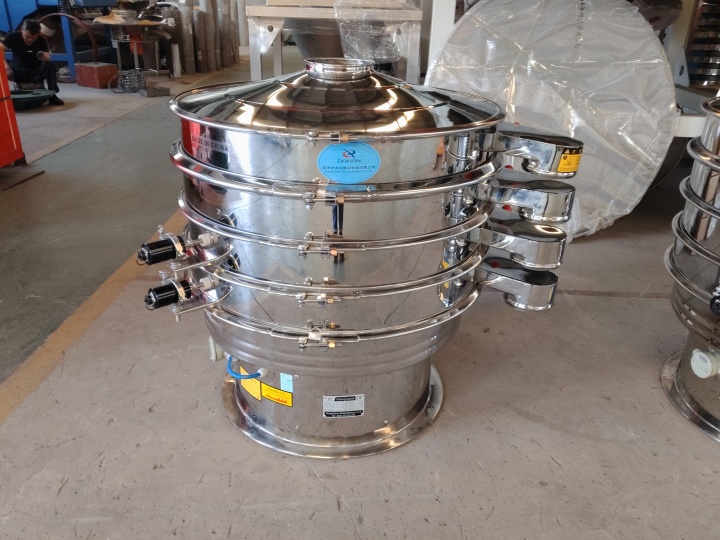
Equipment sealing design needs to examine specific details. A quick-opening clamp ring paired with a high-elasticity sealing ring is convenient for daily cleaning and mesh replacement while maintaining airtightness over the long term. The locking method of the clamp ring directly affects the uniformity of compression of the sealing ring. The micro-negative-pressure dust removal interface is used to connect to the production line's dust removal system to prevent dust from escaping from the feed inlet and discharge outlet during screening. For active or easily oxidized silicon powder, the equipment needs to reserve a nitrogen protection interface, and the interior of the screen body can be filled with inert gas to form a protective atmosphere.
Matching Relationship Between Throughput and Screen Surface Size
There is a contradiction in silicon powder screening. Pursuing precision requires sacrificing throughput, while pursuing output easily leads to coarse particles passing through. Many selection mistakes stem from selecting models based on theoretical throughput while ignoring the effective screening capacity for silicon powder.
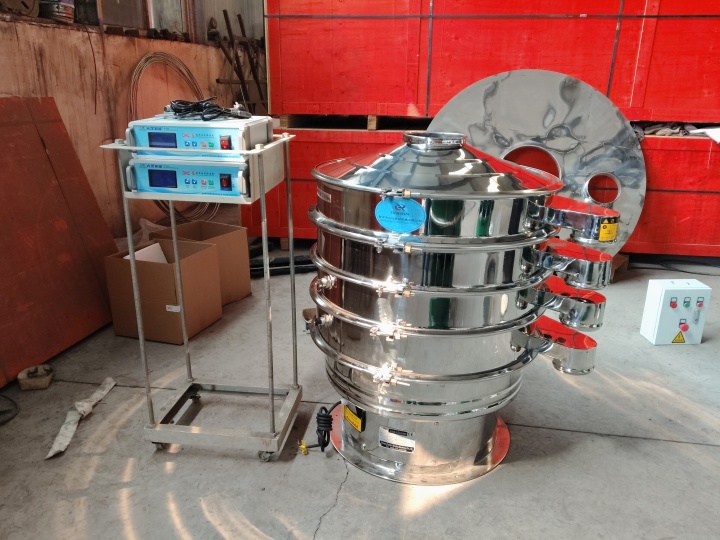
If the material layer thickness of silicon powder on the screen surface exceeds a reasonable range, ultrasonic energy cannot be effectively transmitted to every particle, and blinding will occur rapidly. At the equipment level, this involves the design of the screen surface length-to-width ratio and effective screening area. For screening silicon powder finer than 200 mesh, insufficient screen surface length will lead to insufficient material residence time, and precision cannot be guaranteed. Merely increasing screen surface width without increasing length may increase throughput, but screening efficiency may not improve.
In summary, the selection of a rotary vibrating screen for silicon powder can be summarized as a sequence of checks: first determine the material category, then confirm whether the mesh-cleaning method can address electrostatic adsorption, next verify the screen mesh material and the protective structures at easily worn parts of the screen body, then check the sealing, dust removal, and inert gas interfaces, and finally verify throughput matching based on effective screening area rather than nominal processing capacity.