Stainless Steel Screening Machine Guide: Rotary vs Ultrasonic
Saturday July-18 2026 13:51:18
What Is a Stainless Steel Screening Machine? (Rotary & Ultrasonic Types)
Stainless steel screening machines are industrial devices used for separating, classifying, and filtering solid particles or solid-liquid mixtures based on particle size. These machines use vibrating or rotating motion to force materials through screens with different apertures, effectively grading them or removing impurities.
The "stainless steel" material characteristic is crucial. Machines made of 304 or 316L stainless steel offer corrosion resistance, rust-proof properties, and easy cleanability. This makes them the preferred choice for industries with strict hygiene standards, such as food processing, pharmaceuticals, chemicals, and cosmetics, and they are often required by regulations.
As a broad category, stainless steel screening machines come in various configurations, including rotary vibrating screens, linear screens, tumbler screens, and centrifugal screens. Each type is designed for specific material characteristics and processing requirements. This guide focuses on the two most widely adopted types in the industry.
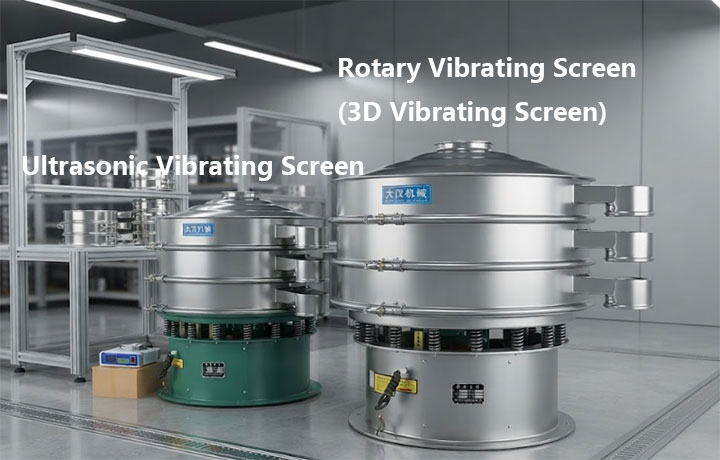
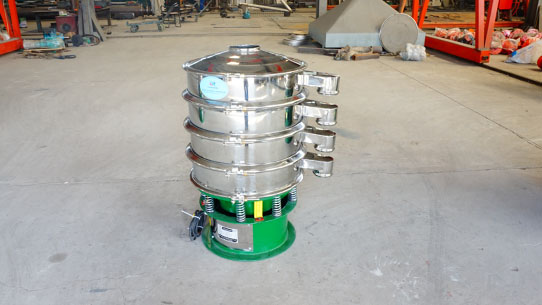
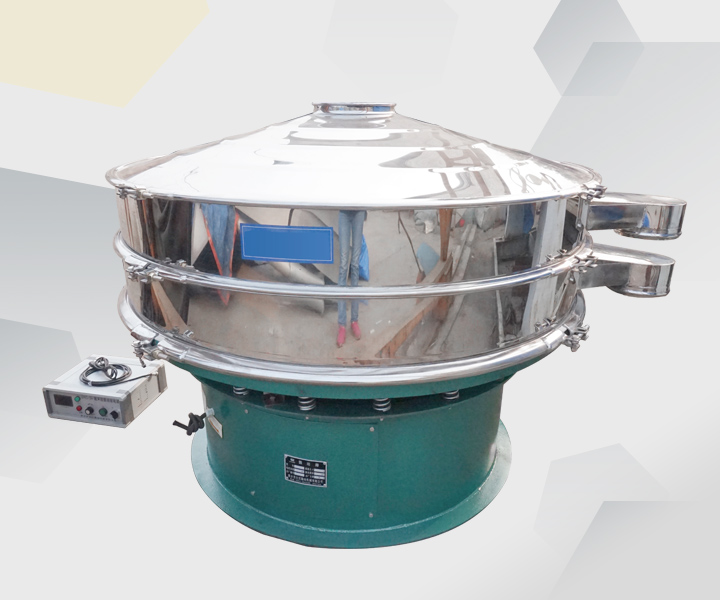
The rotary vibrating screen (also known as a three-dimensional vibrating screen) is a standard, versatile workhorse suitable for most screening applications. For related products, please refer to our Rotary Vibrating Screen product page.
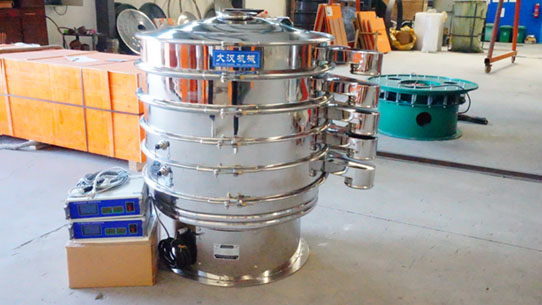
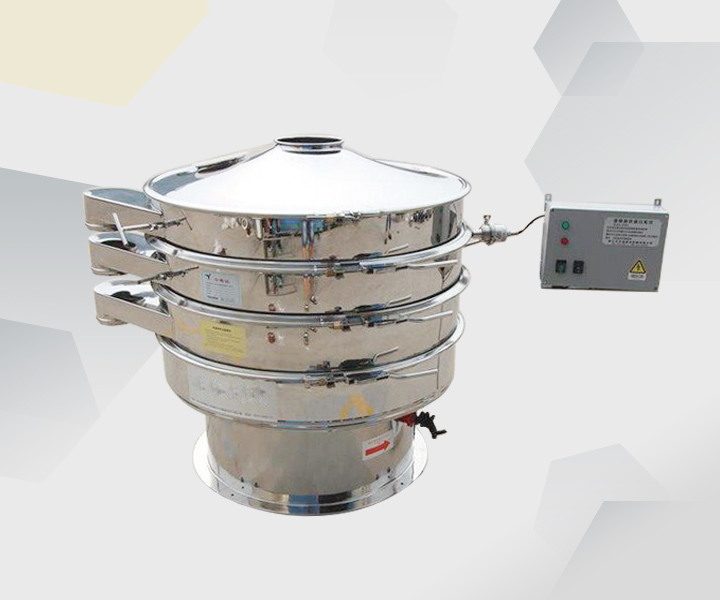
The ultrasonic rotary vibrating screen is an upgraded version that adds high-frequency ultrasonic vibration to the rotary vibrating screen, designed to address screening challenges such as mesh blockage and fine powder agglomeration.
In the following sections, we will explain in detail the working principles and key features of each type, and most importantly, whether your production line should choose a rotary vibrating screen or an ultrasonic rotary vibrating screen.
Rotary Vibrating Screen: Working Principle & Key Features
The rotary vibrating screen, also known as a three-dimensional vibrating screen, is a widely used equipment type in the industrial screening field. Its name derives from its unique three-dimensional vibration principle.
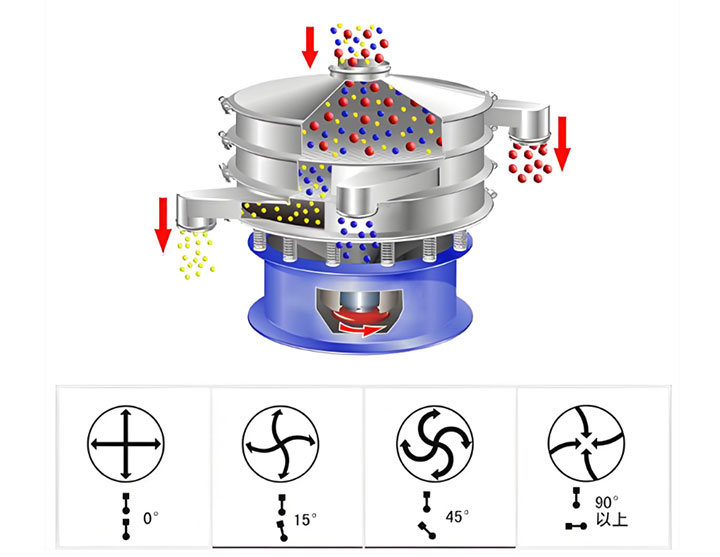
The core power source of this equipment is a vertical vibration motor, with a set of eccentric weights installed at both the upper and lower ends of the motor shaft. When the motor rotates, the upper and lower weights generate combined excitation forces in three directions—horizontal, vertical, and inclined—driving the material to move in a three-dimensional spiral jumping motion across the screen surface. This is the origin of the name "three-dimensional vibration." This motion pattern causes the material to continuously tumble and spread on the screen surface, allowing fine particles to pass through the screen quickly while coarse particles discharge from the opposite end.
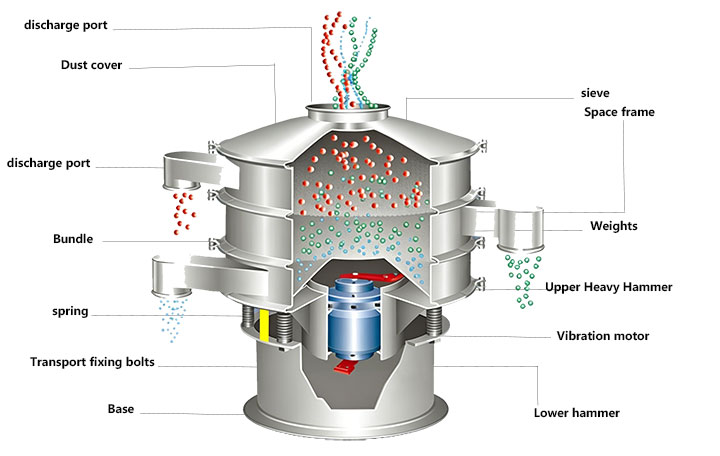
Key Structural Components:
- Screen frames: Typically 1 to 5 layers, enabling 2 to 6 grades of classification
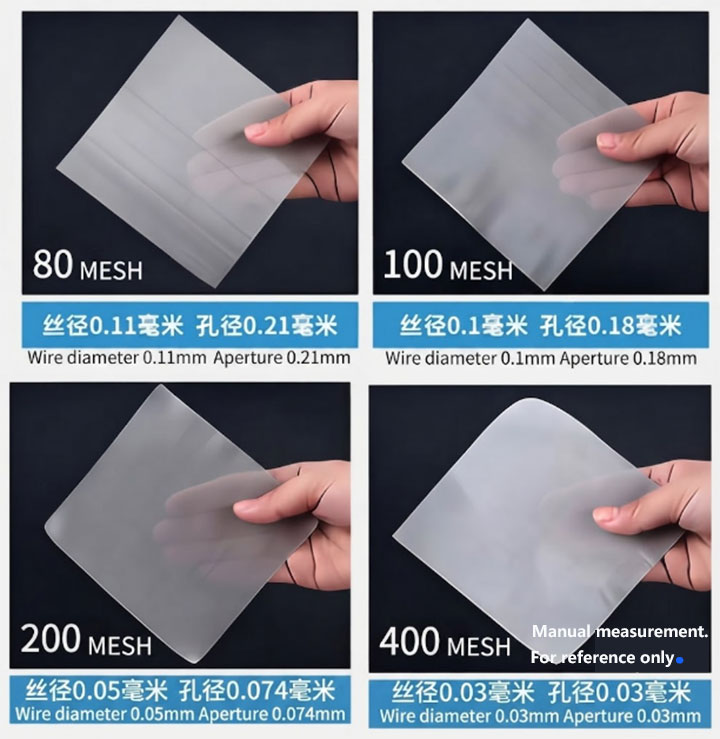
- Stainless steel mesh: Mesh size generally ranges from 4 to 200 mesh (approximately 74 microns to 5 millimeters), depending on material requirements
- Vibration motor: Provides the driving force
- Damping springs: Reduce vibration transmission from the equipment to the floor
- Dust cover / feed port: Prevents dust leakage
- Typical Processing Capacity:A 1200mm-diameter rotary vibrating screen processes flour at approximately 1 to 3 tons per hour, depending on mesh size and material moisture content.
Main Advantages:
- Wide applicability: Handles dry powders, granules, slurries, and other material forms
- Stable screening accuracy: Delivers reliable classification precision for free-flowing conventional materials
- Simple structure: Easy to maintain, with quick mesh change (some models support tool-free screen replacement)
- Multi-layer classification: A single unit achieves multiple particle size separations
- Good sealing: Prevents dust escape and meets environmental requirements
Rotary vibrating screens are widely used in food, chemical, pharmaceutical, metallurgy, and non-metallic mineral industries. Typical materials include flour, starch, resin powder, PVC pellets, ceramic slurries, paints, and fruit juices.
However, when processing ultra-fine powders (above 500 mesh), materials prone to static electricity, or materials with high moisture content, the rotary vibrating screen is prone to mesh blockage. This is precisely the core problem that the ultrasonic rotary vibrating screen is designed to solve.
Ultrasonic Rotary Vibrating Screen: How It Solves Mesh Blockage
When processing ultra-fine powders, static-prone materials, or high-moisture materials, mesh blockage is a common and difficult problem for standard rotary vibrating screens. Blockage not only reduces screening efficiency but also requires frequent shutdowns for cleaning, disrupting production continuity. The ultrasonic rotary vibrating screen is an upgraded solution designed specifically to address this pain point.
How the Ultrasonic Rotary Vibrating Screen Works
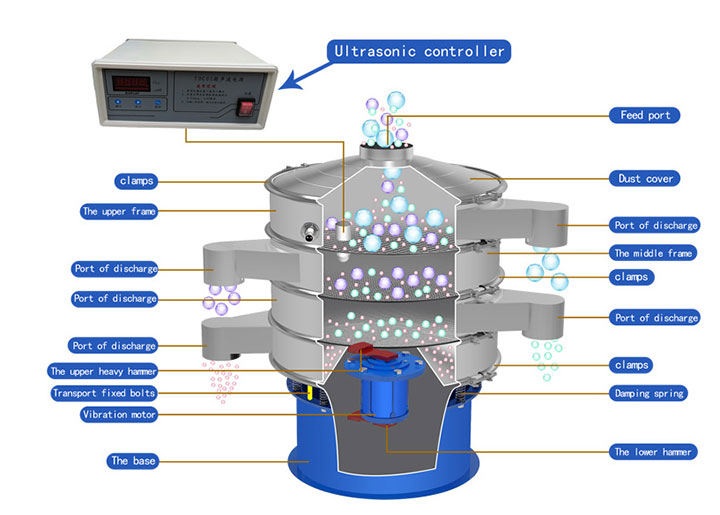
The ultrasonic rotary vibrating screen adds an ultrasonic system to the standard rotary vibrating screen. This system consists of two main components: an ultrasonic generator and a transducer.
- Ultrasonic generator: Converts conventional electrical power into high-frequency electrical signals (typically 30-40 kHz)
- Transducer: Converts the high-frequency electrical signals into mechanical vibration at the same frequency and transmits it to the screen mesh
The key to this system is that the ultrasonic vibration acts directly on the screen mesh, causing the mesh itself to vibrate at high frequency (approximately 30,000-40,000 times per second). This high-frequency vibration continuously breaks down adhesion, electrostatic attraction, and surface tension between the material and the screen mesh, keeping the material in a "suspended" state for smooth passage.In simple terms, a standard rotary vibrating screen relies on the material "bouncing" on the screen surface to separate particles, while the ultrasonic rotary vibrating screen makes the screen mesh itself "actively vibrate" for continuous self-cleaning.
Key Advantages of the Ultrasonic Rotary Vibrating Screen
Compared to the standard rotary vibrating screen, the ultrasonic version delivers significant improvements:
- Effective mesh blockage prevention: High-frequency vibration keeps the screen mesh in a continuous self-cleaning state, greatly reducing material adhesion and blockage
- Higher screening accuracy: Processes ultra-fine powders down to 500 mesh (approx. 28 microns) —and in many applications, down to 635 mesh (approx. 20 microns)
- Increased throughput: For difficult-to-screen materials, processing capacity can be 1 to 10 times higher than standard rotary vibrating screens (actual improvement depends on material characteristics; for 325-mesh carbon powder, users typically report a 5-7x increase)
- Reduced downtime: No need for frequent shutdowns to clean the screen mesh, ensuring better production continuity
- Suitable for special materials: Particularly effective for materials prone to agglomeration, static electricity, or strong adhesion
Ultrasonic rotary vibrating screens are widely used in the following fields:
- Fine chemicals: Dyes, pigments, carbon powder, titanium dioxide
- Pharmaceuticals: Ultra-fine pharmaceutical powders, pharmaceutical excipients
- Food processing: Ultra-fine starch, milk powder, protein powder
- Metallurgical powders: Metal powders, alloy powders for high-precision classification
- New materials: Battery materials (e.g., lithium iron phosphate), graphene
Case Example: A lithium battery material manufacturer processing lithium iron phosphate (average particle size 25 microns) experienced severe mesh blockage on a standard rotary vibrating screen, requiring cleaning every 30 minutes. After switching to an ultrasonic rotary vibrating screen, the company achieved continuous 8-hour operation without screen cleaning, increasing daily output from 2 tons to 12 tons.
When your material exhibits any of these characteristics—ultra-fine, static-prone, agglomeration-prone, or poor flowability—the ultrasonic rotary vibrating screen should be your first choice. For conventional powders or granules, the standard rotary vibrating screen is generally sufficient.
Rotary vs Ultrasonic: 5 Key Differences You Should Know
Through the previous two chapters, we have gained a clear understanding of the working principles, advantages, and application scenarios of both the rotary vibrating screen and the ultrasonic rotary vibrating screen. Next, we will directly compare the two across five key technical dimensions: function, efficiency, screening mesh size, power configuration, and screen cleaning performance.Please refer to the comparison table below for a side-by-side evaluation of these two models across the five dimensions.
Rotary Vibrating Screen vs Ultrasonic Rotary Vibrating Screen: 5 Key Comparisons
| Comparison Dimension | Rotary Vibrating Screen (Standard) | Ultrasonic Rotary Vibrating Screen (Upgraded) |
|---|---|---|
| Function | General-purpose screening equipment for classification and impurity removal of conventional powders, granules, and slurries | Adds an ultrasonic system to standard screening, specifically designed for difficult-to-screen materials |
| Efficiency | Stable efficiency for free-flowing conventional materials; efficiency drops significantly for materials prone to mesh blockage | Significantly higher efficiency for difficult materials; throughput can be 1-10 times higher than standard models |
| Screening Mesh Size | Standard range: 4-200 mesh (approx. 74 microns to 5 mm) | Fine range: up to 500-635 mesh (approx. 28 microns), with a higher precision ceiling |
| Power Configuration | Driven by vibration motor only, with lower energy consumption | Vibration motor + ultrasonic generator (30-40 kHz), with slightly higher overall energy consumption |
| Screen Cleaning Performance | Relies on the material's own bouncing force; no active cleaning function; requires shutdown for cleaning when blockage occurs | Screen mesh generates high-frequency micro-vibrations (approx. 30,000-40,000 times per second) for continuous self-cleaning, greatly reducing downtime for maintenance |
How to Choose the Right Screening Machine for Your Material
The final choice of screening equipment always depends on your material characteristics and production requirements. When selecting a vibrating screen, you can refer to the following three aspects to find the model that best fits your production line.
Consideration 1: Determine which category your material falls into
| Material Type | Characteristics | Recommended Model |
|---|---|---|
| Conventional materials | Good flowability, non-sticky to mesh, particle size within 200 mesh | Rotary vibrating screen (standard model is sufficient) |
| Difficult-to-screen materials | Ultra-fine (above 500 mesh), static-prone, agglomeration-prone, sticky, high moisture content | Ultrasonic rotary vibrating screen (solves the core problem of mesh blockage) |
You can quickly assess this by evaluating whether your material is conventional (good flowability, non-sticky, within 200 mesh) or difficult-to-screen (ultra-fine above 500 mesh, static-prone, agglomeration-prone, sticky, or high moisture content). The former is best served by a standard rotary vibrating screen, while the latter typically requires an ultrasonic rotary vibrating screen.
Consideration 2: Clarify your screening accuracy and throughput requirements
If your accuracy requirement is within 200 mesh and the throughput is moderate, the standard rotary vibrating screen is the most cost-effective choice. If you need to process ultra-fine powders above 500 mesh, or if your throughput is high and the material is difficult to screen, the ultrasonic rotary vibrating screen—although requiring a higher initial investment—can quickly pay for itself through reduced downtime and improved screening efficiency.
Consideration 3: Evaluate operating costs and maintenance convenience
The standard rotary vibrating screen has a simple structure, low energy consumption, and easy maintenance, making it suitable for long-term processing of conventional materials. The ultrasonic rotary vibrating screen adds an ultrasonic system, resulting in slightly higher energy and maintenance costs. However, if your material causes frequent mesh blockage, the production losses from shutdowns and cleaning often far exceed the equipment cost difference—in which case the ultrasonic rotary vibrating screen is actually more economical in the long run.
Not sure which one to choose? We can help you decide.
Our team has over a decade of experience in screening equipment, having helped customers across 40+ countries find the right solution. If you are still uncertain about which model suits your production line, please provide the following information and we will offer a free, no-obligation selection recommendation:
- Material name:
- Throughput requirement: (kg/hour or tons/hour)
- Screening purpose: (impurity removal? classification? or filtration?)
- Material characteristics: (static-prone? agglomeration-prone? high moisture content?)
Based on your specific material properties, we will provide a tailored selection plan at the earliest opportunity.